Search

The Importance of Static Control in Hazardous (Ex) Environments

The Importance of Static Control in Hazardous (Ex) Environments

Posted

16.06.2026

Written by

Nick Freer

Introduction

Hazardous or explosive (Ex) environments are locations where flammable gases, vapours, dusts, or fibres may be present in the atmosphere in sufficient concentrations to pose a risk of fire or explosion. Such environments are commonly found in industries including oil refineries, chemical processing plants, manufacturing facilities, grain handling operations, and fuel storage depots. When these substances mix with air under the right conditions, they can form an explosive atmosphere in which even a minor ignition source such as a spark, hot surface, or static discharge can initiate a rapid and potentially devastating reaction. Among these ignition sources, electrostatic discharge or static electricity, is often overlooked despite being a significant and well-documented hazard in Ex environments. Static electricity, if not properly controlled, poses a significant risk in Ex zones. This makes static control not just a good engineering practice, but a fundamental safety requirement.

What is Static Electricity?

Static electricity is the accumulation of electrical charge on the surface of materials, typically generated through friction, separation, or flow (e.g., liquids moving through pipes). When the charge builds up sufficiently, it can discharge suddenly in the form of a spark.

In everyday life, such sparks are harmless (e.g., touching a door handle after walking on carpet). However, in Ex environments, these sparks can have enough energy to ignite explosive atmospheres.

Sources of Static in Ex Environments

Common sources of electrostatic charge in hazardous areas include:

  • Fluid transfer operations (fuel loading/unloading, solvents pumping)
  • Powder handling and conveying (grain, chemicals, pharmaceuticals)
  • Movement of personnel (walking, removing clothing)
  • Non-conductive materials (plastics, coatings, containers)
  • High-velocity air or gas flows

These processes can generate charges that accumulate if not safely dissipated.

Why Static Control is Critical

The list provided below is why static control is so critical:

Prevention of Ignition Sources – the primary reason for static control is to eliminate electrostatic sparks, which can ignite flammable atmospheres. A discharge as low as a few millijoules can ignite certain gases or vapours. Without proper grounding and bonding static charge builds up, a potential difference develops, sudden discharge occurs and ignition risk increases dramatically.

Protection of Personnel Safety – Electrostatic discharges can directly harm workers or indirectly create dangerous situations. Ignition of the discharges can cause burns, blast injuries, or fatalities. They can also startle reactions leading to accidents and there is an increased risk during routine operations like tank filling or powder transfer. Effective static control ensures a safer working environment and reduces accident likelihood.

Compliance with Regulations and Standards – Several international standards and directives require strict control of electrostatic hazards in Ex environments and failure to comply can result in legal penalties, plant shutdowns, increased liability. Below are some examples of regulations and standards to follow:

  • ATEX Directives 2014/34/EU (Europe)
  • IEC 60079-32-1 (Explosive atmospheres – Electrostatic hazards)
  • National Fire Protection Association (NFPA) 77 (Recommended Practice on Static Electricity)
  • American Petroleum Institute (API) Standards API RP 2003: Protection against Ignitions Arising out of Static, Lightning and Stray Currents (USA)

Protection of Equipment and Infrastructure – Electrostatic discharges can damage sensitive instrumentation, degrade electronic systems and cause premature equipment failure. In industries with automation or digital control systems, Emergency Shutdowns (ESD) can lead to costly downtime and repairs.

Maintaining Product Quality – in certain industrial sectors, (pharmaceuticals, electronics, and coatings) static can attract dust and contaminants, causing uneven coating or powder distribution and leading to product defects. Therefore, controlling static improves both safety and production quality.

Key Methods of Static Control

The below are key controls to reduce static electricity and reduce the risk of static accumulation:

  • Grounding and Bonding – Grounding is when equipment is connected to earth to dissipate charge and bonding is when conductive objects are connected to equalise potential. These are essential for tanks, drums, pipelines, transfer systems and machinery.
  • Use of Conductive and Antistatic Materials – replacing insulating materials with conductive alternatives and using antistatic coatings/additives and static-dissipative hoses and containers.
  • Environmental Control – environments where maintaining higher humidity can help reduce static buildup as well as controlling airflow and velocity.
  • Static Monitoring and Detection – modern systems used for monitoring and detection are ground monitoring devices, static charge sensors and interlock systems preventing operation unless grounding is confirmed.
  • Personnel Protection Measures – As a last resort to protect personnel antistatic clothing and footwear can be worn and conductive flooring systems implemented.
  • Avoid splash filling – using a dip tube or bottom‑fill method to minimise static electricity buildup within the tanks. Filling from below the liquid surface significantly reduces turbulence, splashing, and the entrainment of air, all of which can generate electrostatic charge. By keeping the inlet submerged during filling, the liquid flows more smoothly and dissipates charge more effectively, reducing the risk of static discharge that could ignite flammable vapours.

Consequences of Poor Static Control

Failure to manage electrostatic hazards can result in:

  • Fires and explosions
  • Loss of life or injury
  • Environmental damage
  • Financial losses and downtime
  • Reputational harm

Historical industrial incidents have repeatedly shown that static electricity can be a primary ignition source when controls are inadequate.

Case Study of Static Electricity incident - Barton Solvents, Kansas

Site: Barton Solvents, Wichita Facility in Valley Centre, Kansas

Incident: Naphtha Tank explosion from static accumulation during offloading

Date: July 17, 2007, at about 9 a.m.

Injuries: Eleven residents and one firefighter received medical treatment

Background: The initial explosion occurred soon after the tank farm supervisor started the transfer of the final compartment of a tanker-trailer containing Varnish Makers’ and

Painters’ (VM&P) naphtha into a 15,000 gallon above-ground storage tank. VM&P naphtha is a National Fire Protection Association (NFPA) Class IB flammable liquid (Flash point: below 22.8 °C (73 °F) & Boiling point: at or above 37.8 °C (100 °F)) that can produce ignitable vapour-air mixtures inside tanks and, because of its low electrical conductivity, can accumulate dangerous levels of static electricity.

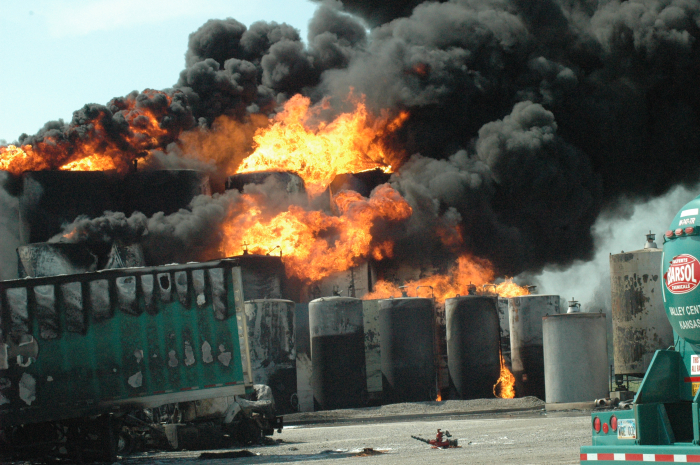
The explosion propelled the VM&P tank into the air, pouring out a plume of smoke and flames from the burning liquid before it landed approximately 130 feet away. Witnesses heard the blast and observed the fireball from several miles away. Within moments, two additional tanks ruptured, releasing their contents into the rapidly intensifying fire, which was largely contained within the earthen bund surrounding the tank farm.

As the fire progressed, other tanks either over-pressurised or ignited, sending debris such as steel tank tops (10–12 feet in diameter), vent valves, pipes, and other metal fragments beyond the site boundary and into the neighbouring community. One tank top struck a mobile home around 300 feet away, while a pressure/vacuum valve landed near a nearby business almost 400 feet from the site.

Figure 1: Image of static electricity explosion which occurred at Barton Solvents, Kansas2

Key Findings: The Chemical Safety Board determined that several factors likely combined to produce the initial explosion:

  • The tank contained an ignitable vapour-air mixture in its head space.
  • Stop-start filling, air in the transfer piping, and sediment and water (likely present in the tank) caused a rapid static charge accumulation inside the VM&P naphtha tank.
  • The tank had a liquid level gauging system float with a loose linkage that likely separated and created a spark during filling.
  • The MSDS for the VM&P naphtha involved in this incident did not adequately communicate the explosive hazard.

Good Examples of Methods of Static Control

Finch has found some good examples across different sites and industries to help control static discharge. Below are some examples which we have seen:

  • Use of an Earth-Rite unit manufactured by Newson Gale (other equivalent manufacturers of similar technology have also been seen). The Earth-Rite unit has typically been used for earthing road tankers, mobile vessels, or drums and there is a red and green light present to show negative and positive ground connection. The light stays red when an earth hasn’t been found and turns green when the clamp has been properly earthed. Typically, there is an interlock in the system so the tanker offload cannot be completed unless the earth is connected and turns green. This is great visibility for the operators to help support them to identify whether the tanker or drum is properly grounded or not.

Figure 2: Example of Earth-Rite unit by Newson Gale for grounding connection3

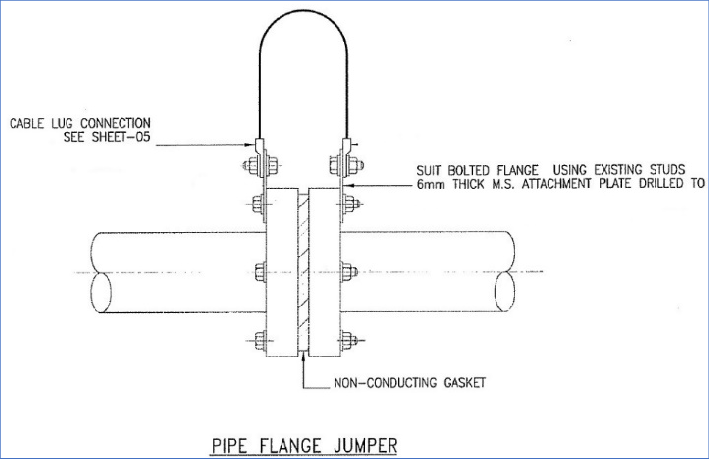
  • Use of suitable bonding across flanges of pipework when non-conducting gaskets are used to reduce the likelihood of static build up within the pipework. See the example in Figure 2 below. It is a common but incorrect assumption that bolted flange connections provide sufficient electrical continuity between pipework sections. Often the metal-to-metal contact between the flange bolts can be unreliable due to corrosion or rust on bolts, paints or coatings and contaminants on the mating surfaces. Without bonding, static charge can build up on one side of the flange and discharge as a spark. Bonding straps ensure a low resistance path (<0.1 Ω is typical) across the joint. This is why it is important to check the electrical continuity as part of a preventative maintenance programme to ensure there is still a low resistance electrical path.

Figure 3: A good example of pipe flange jumper with non-conducting gasket4

Best Practices for effective Static Control

To ensure effective static control in Ex environments:

  • Undertake detailed hazard assessments across all processes, explicitly addressing ignition risks associated with static electricity.
  • Ensure all key equipment and pipework are effectively bonded and grounded to prevent the accumulation of static electricity.
  • Implement a programme of routine inspection and testing of grounding and bonding systems to confirm their integrity, continuity, and ongoing effectiveness in controlling static electricity hazards.
  • Train personnel on electrostatic risks.
  • Use certified Ex equipment suitable for hazardous areas.
  • Anti-static / dissipative clothing and footwear for personnel working in Ex areas
  • Follow applicable standards and guidelines.

Conclusion

Static control is a critical process safety component in hazardous (Ex) environments. While often invisible, electrostatic hazards can have devastating consequences if ignored. By implementing proper grounding and bonding, using appropriate materials, following regulatory standards, and maintaining awareness, organisations can significantly reduce the risk of ignition and ensure safe operations.

In Ex environments, controlling static electricity is not just about managing charge, it is about protecting lives, assets, and the integrity of industrial processes.

References

  1. Chemical Safety Board (CSB) – Barton Solvents Case Study – pdf
  2. One Spark Article from NFPA – One Spark | NFPA Journal
  3. Newson Gale Grounding and Bonding Handbook Volume 5 – Leading the way in hazardous area static control
  4. Research Gate Practical Bonding of Industrial Piping in Hazardous Areas: Standards, Implementation, and Field Examples: Field-based grounding methods for safety in oil & gas operations Flange jumper bonding schematic across non-conductive gasket (per IEC… | Download Scientific Diagram

Related insights

Finch Consulting
Privacy Overview

This website uses cookies so that we can provide you with the best user experience possible. Cookie information is stored in your browser and performs functions such as recognising you when you return to our website and helping our team to understand which sections of the website you find most interesting and useful.